StudyEezy
Helping students spend less time preparing to study and more time actually learning.
Project Summary
Category
EdTech
Project Type
Personal Project
Role
Product Engineer
Platform
Responsive Web Application
Status
Live
Team
Solo Project
Responsibilities
- Product Strategy
- UX Research
- Information Architecture
- User Flow Design
- Wireframing
- UI Design
- Design System
- Product Engineering
- AI Integration
- Frontend Development
Technology Stack
- Next.js
- TypeScript
- Tailwind CSS
- Firebase
- DeepSeek API
- Google Vision API
- Progressive Web App (PWA)
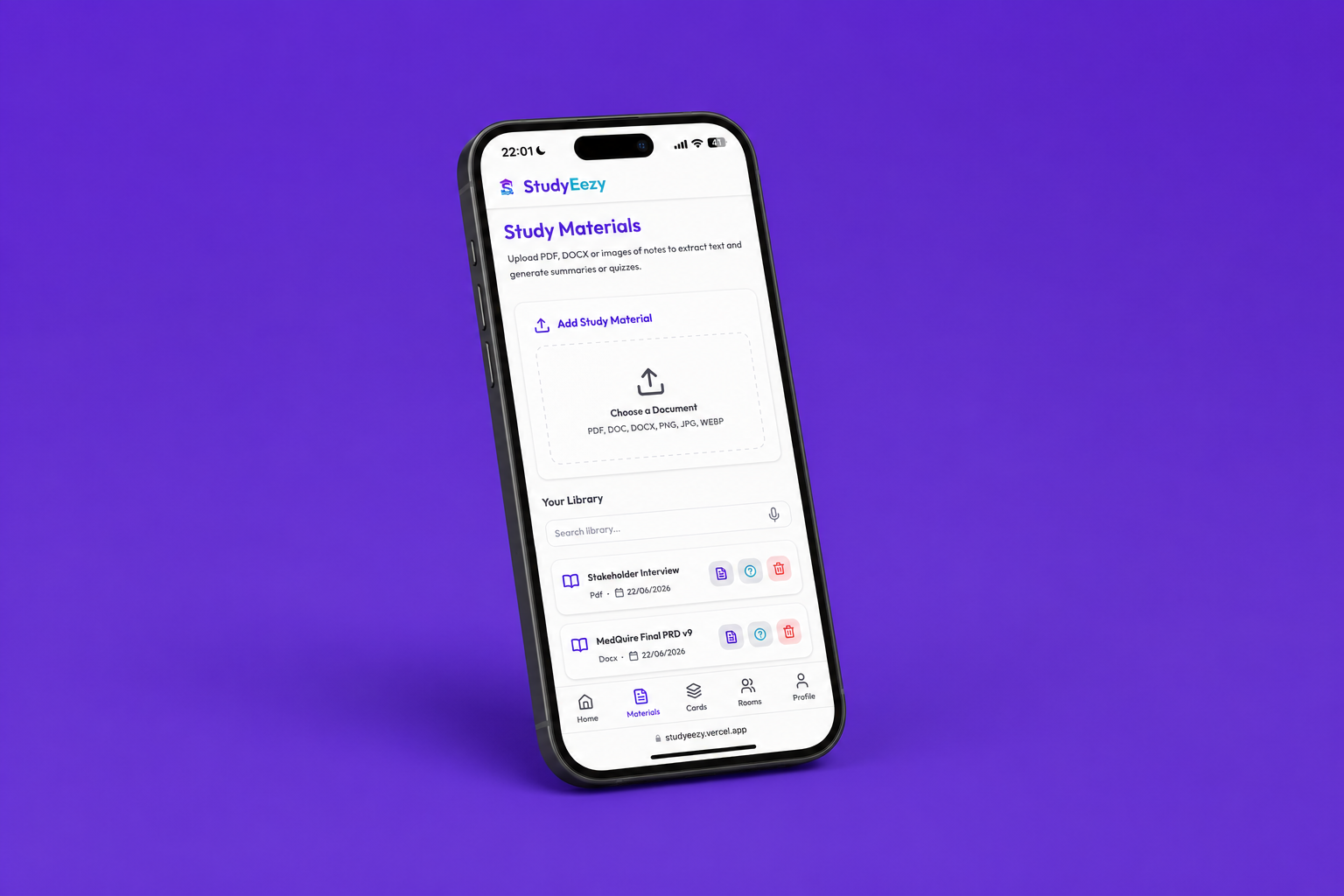
Project Links
Live Application
The Story
Studying effectively was never my problem. Preparing to study was.
During my undergraduate years, I realized that I learned best when I actively engaged with my study materials instead of simply reading them repeatedly.
I would summarize lecture notes into simpler versions, create practice questions for myself, turn important concepts into flashcards, and study with friends, ask questions, and challenge one another.
Those activities consistently helped me understand concepts more deeply and remember them for longer.
The problem was that preparing all of those learning materials took an enormous amount of time. Sometimes I spent almost as much time preparing to study as I spent actually studying.
Years later, as AI tools became more capable, I started asking a different question: What if AI could eliminate the repetitive work involved in studying without eliminating the learning itself?
That question became StudyEezy.
Rather than replacing students with AI, I wanted to build a platform that encourages active learning while allowing AI to handle the repetitive preparation.
Research and Discovery
Many students understand that active learning techniques produce better results than passive reading.
Methods such as summarizing notes, creating flashcards, taking quizzes, discussing concepts with peers, and testing recall repeatedly are widely recognized as effective learning strategies.
The problem is that these activities require significant preparation. Students often postpone them because creating the necessary learning materials takes time.
As deadlines approach, many fall back on passive reading or last-minute cramming, not because these methods are more effective, but because they're faster to begin.
At the same time, modern AI tools introduced another concern. Many platforms focused on giving students answers rather than helping them understand concepts Instead of encouraging active learning, they often encouraged dependency.
This raised an important design question: How might we use AI to improve learning without allowing AI to replace learning?
Key Insights
Several insights guided the design of StudyEezy.
Students learn by doing.
Understanding improves when learners actively summarize, recall, explain, and apply knowledge.
Preparation creates friction.
Creating summaries, quizzes, and flashcards manually takes time that could be spent learning.
Collaboration strengthens understanding.
Explaining concepts, debating ideas, and answering peer questions reinforce long-term memory.
AI should support learning, not replace it.
Giving students immediate answers may save time, but it doesn't always improve understanding.
StudyEezy was intentionally designed to encourage participation instead of dependency.
Product Philosophy
Every product needs a guiding principle.
For StudyEezy, that principle became: AI shouldn't replace learning. It should remove the repetitive work that gets in the way of learning.
This philosophy influenced every feature within the platform.
AI generates summaries, students still read them.
AI creates flashcards, students still test themselves.
AI generates quizzes, students still answer the questions.
Study rooms encourage students to discuss concepts before requesting AI feedback.
Even AI Reviews are intentionally designed to evaluate student answers rather than answer questions immediately.
The objective isn't to build another AI chatbot, the objective is to build better learners.
Target Users
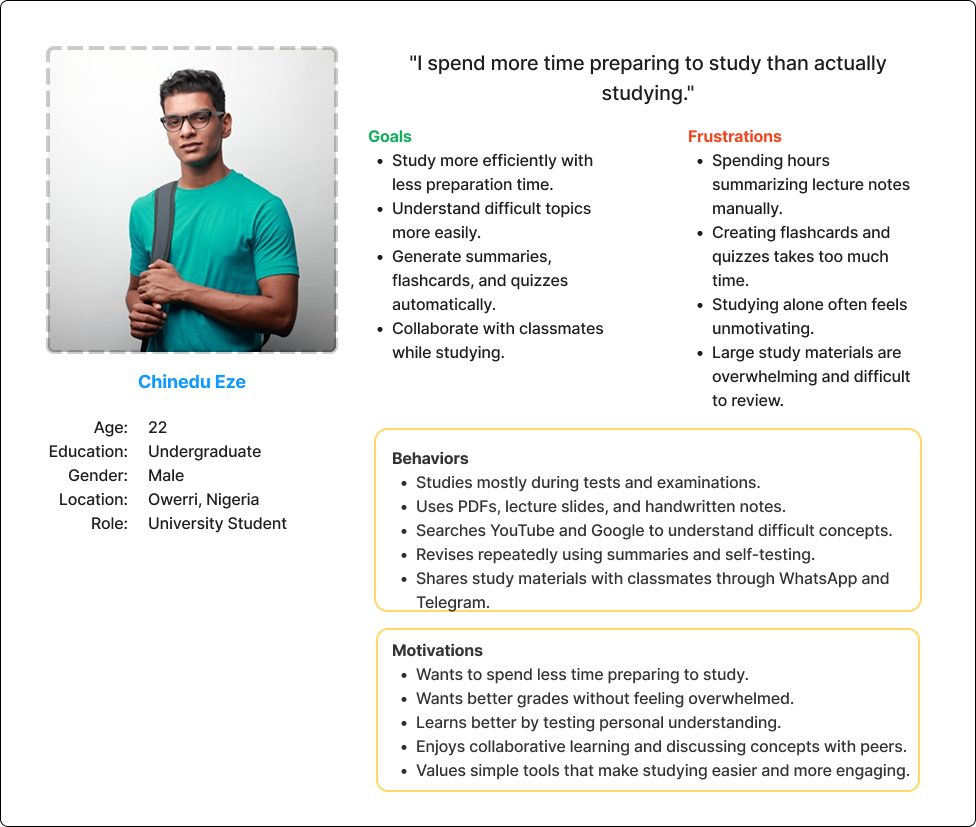
Primary users include:
- University students.
- College students.
- Students preparing for examinations.
- Self-directed learners.
Secondary users include:
- Study groups.
- Peer learning communities.
- Tutors.
- Anyone preparing for certifications or professional exams.
Although these users have different goals, they all benefit from reducing preparation time while maintaining active learning habits.
MVP Features
Upload Study Materials
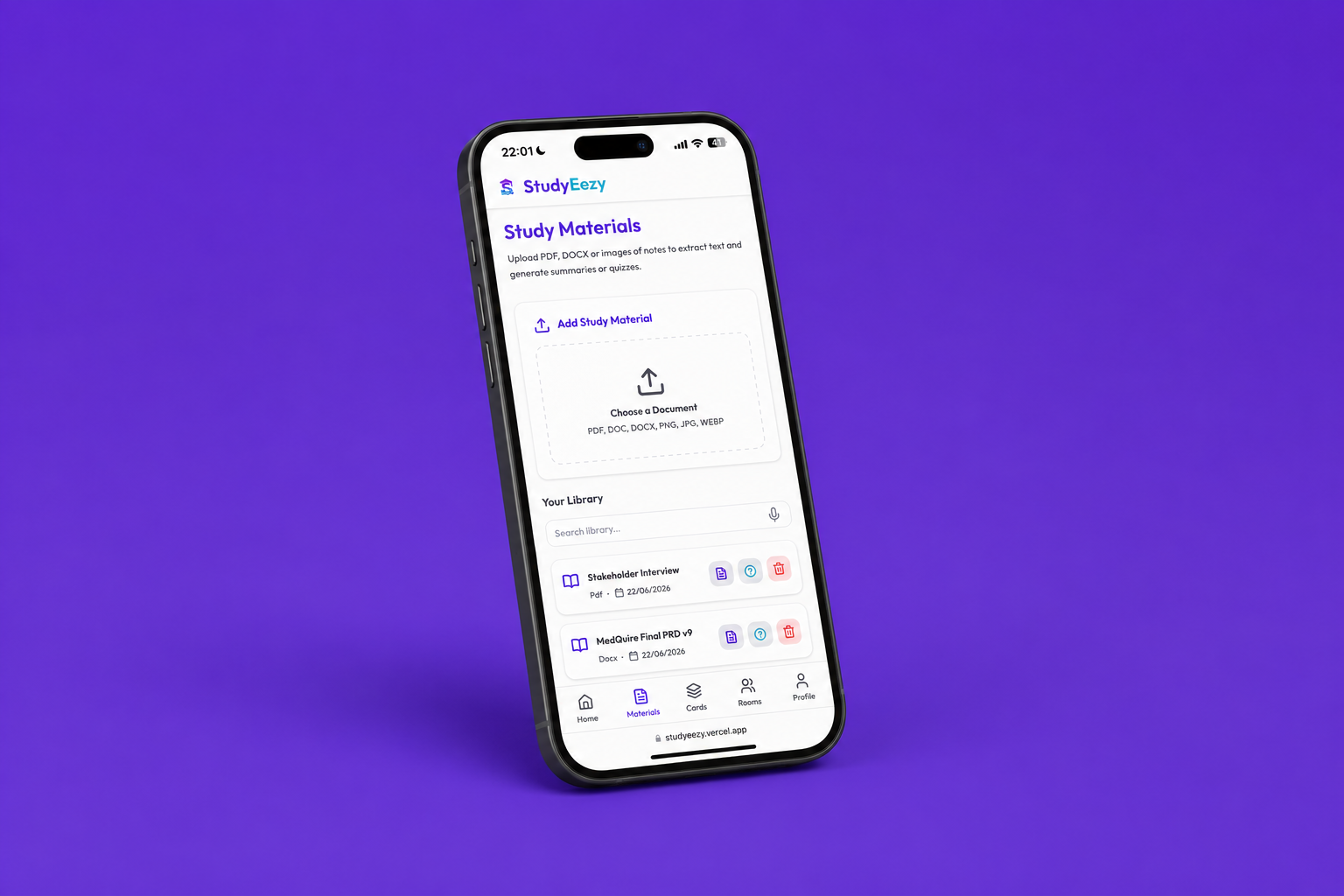
Students can upload PDFs, Word documents, lecture slides, images, or capture notes directly from their device.
This creates a single source of truth from which all learning materials are generated.
AI Summaries
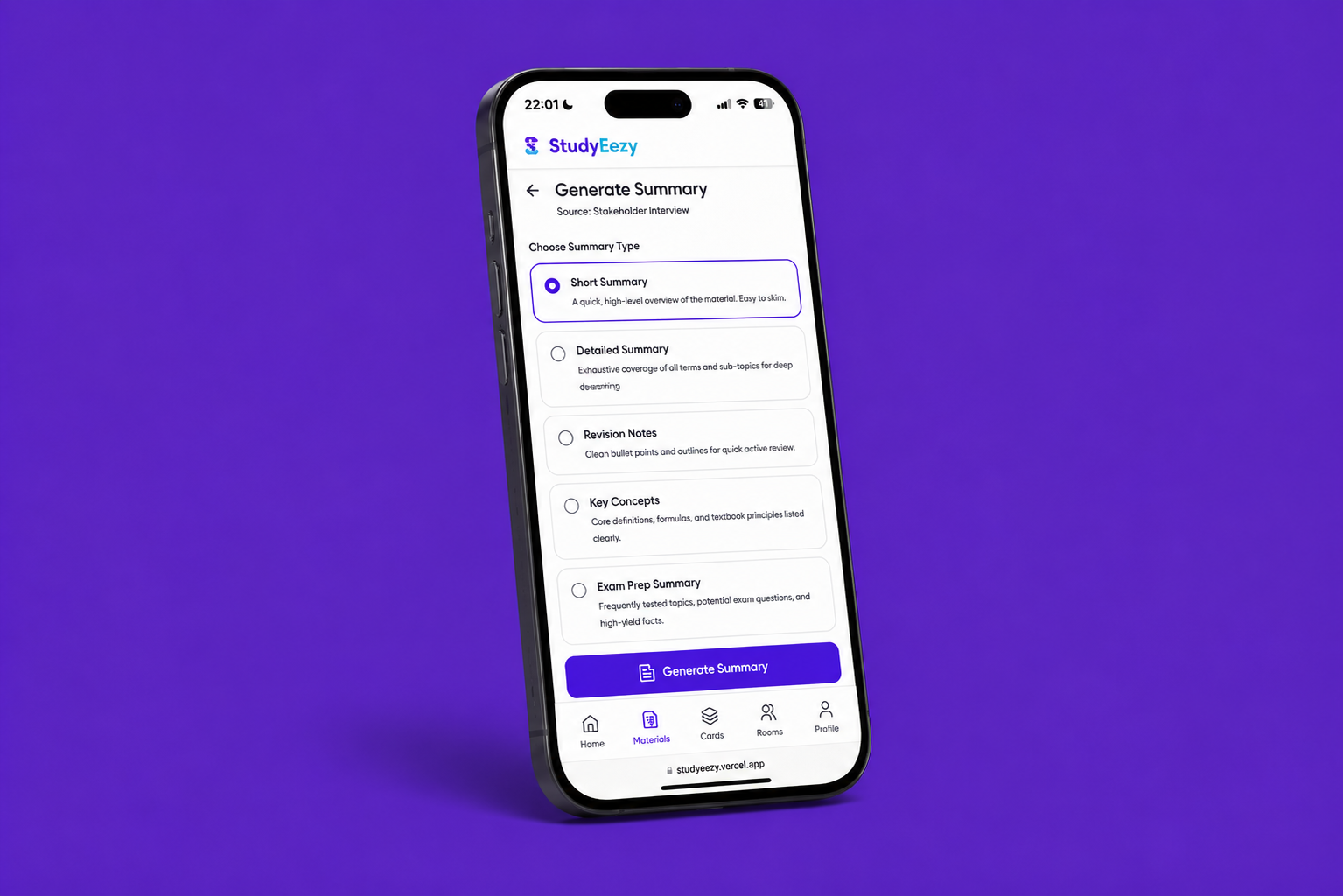
Instead of reading lengthy lecture notes repeatedly, students can generate concise summaries that highlight the most important concepts.
AI Flashcards
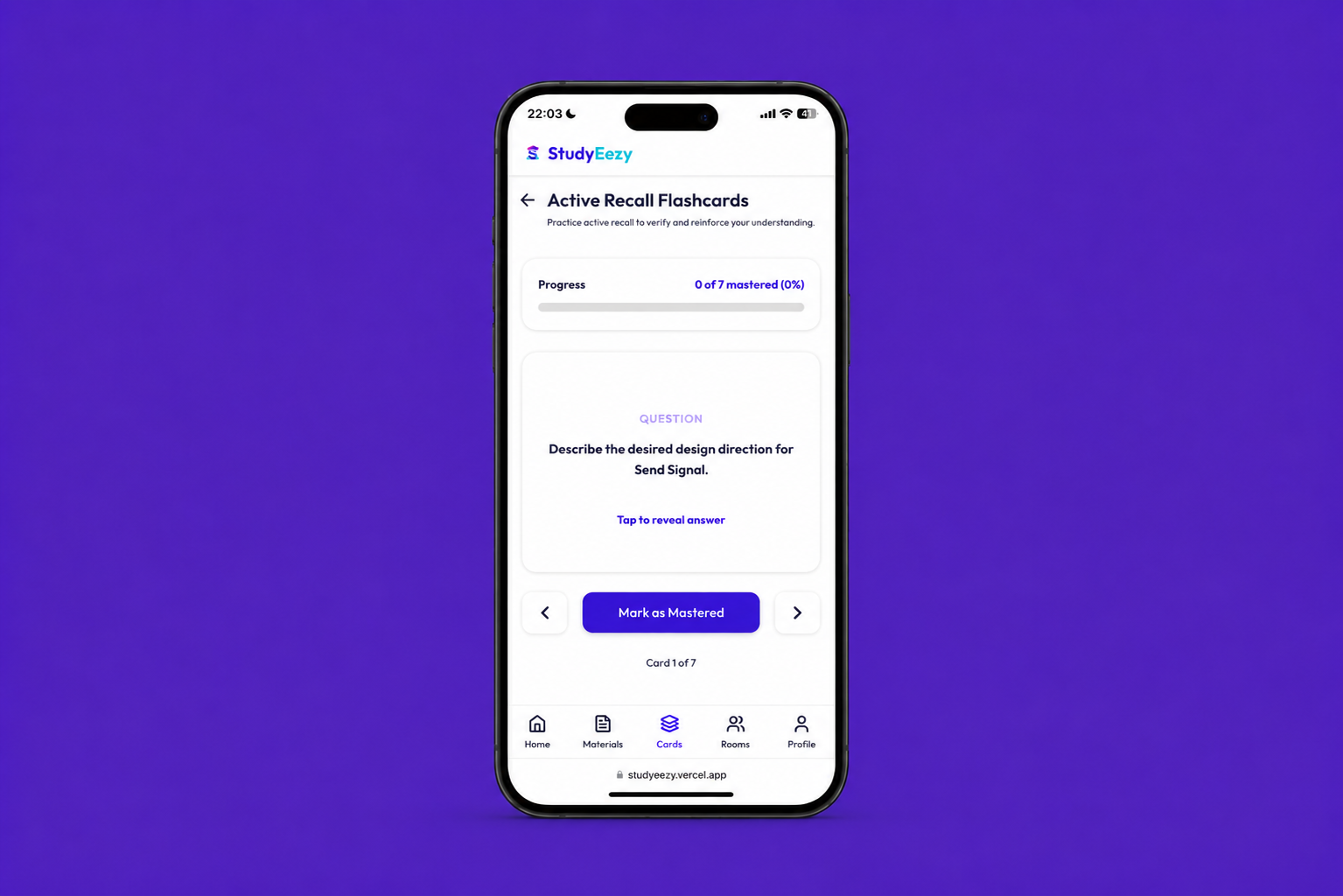
Flashcards transform passive reading into active recall.
StudyEezy automatically generates flashcards from uploaded materials, allowing students to reinforce concepts through repetition instead of memorization alone.
AI Quiz Generator
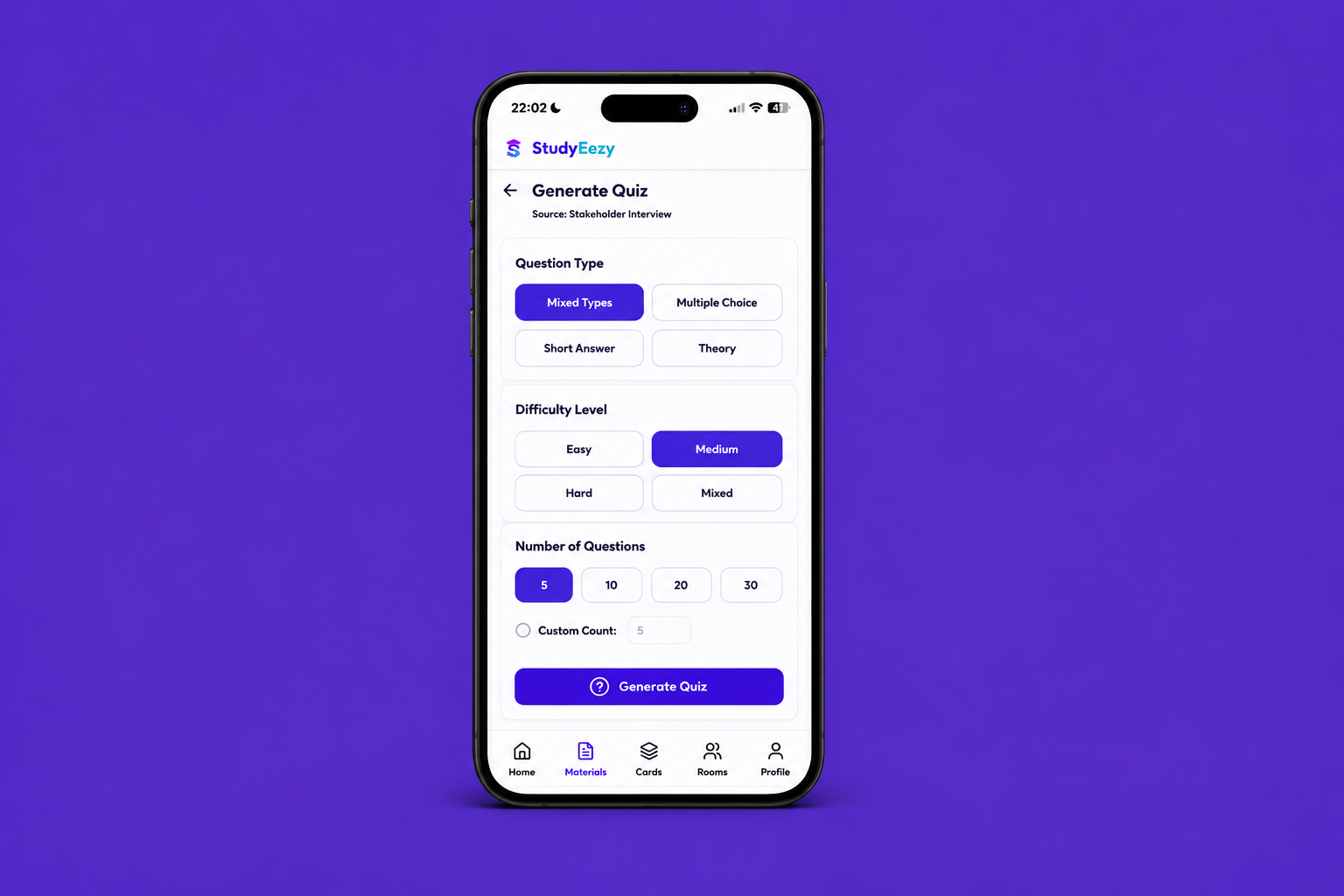
StudyEezy generates quizzes from uploaded study materials, allowing students to assess their understanding instead of assuming they've learned the content.
Different question formats and difficulty levels help make revision more engaging.
Study Rooms
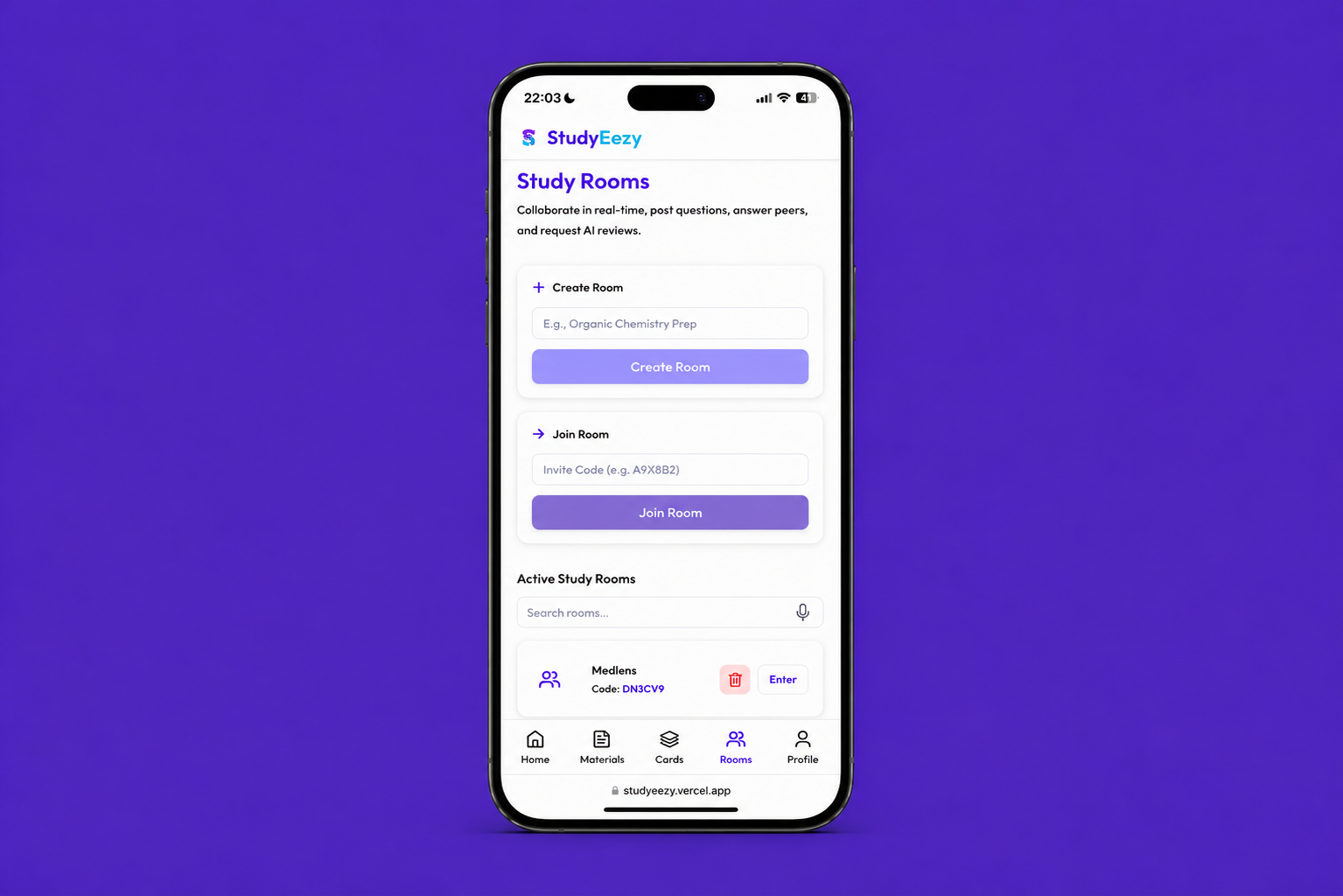
Study Rooms allow students studying the same course or topic to collaborate, ask questions, explain concepts, and challenge one another.
AI Review
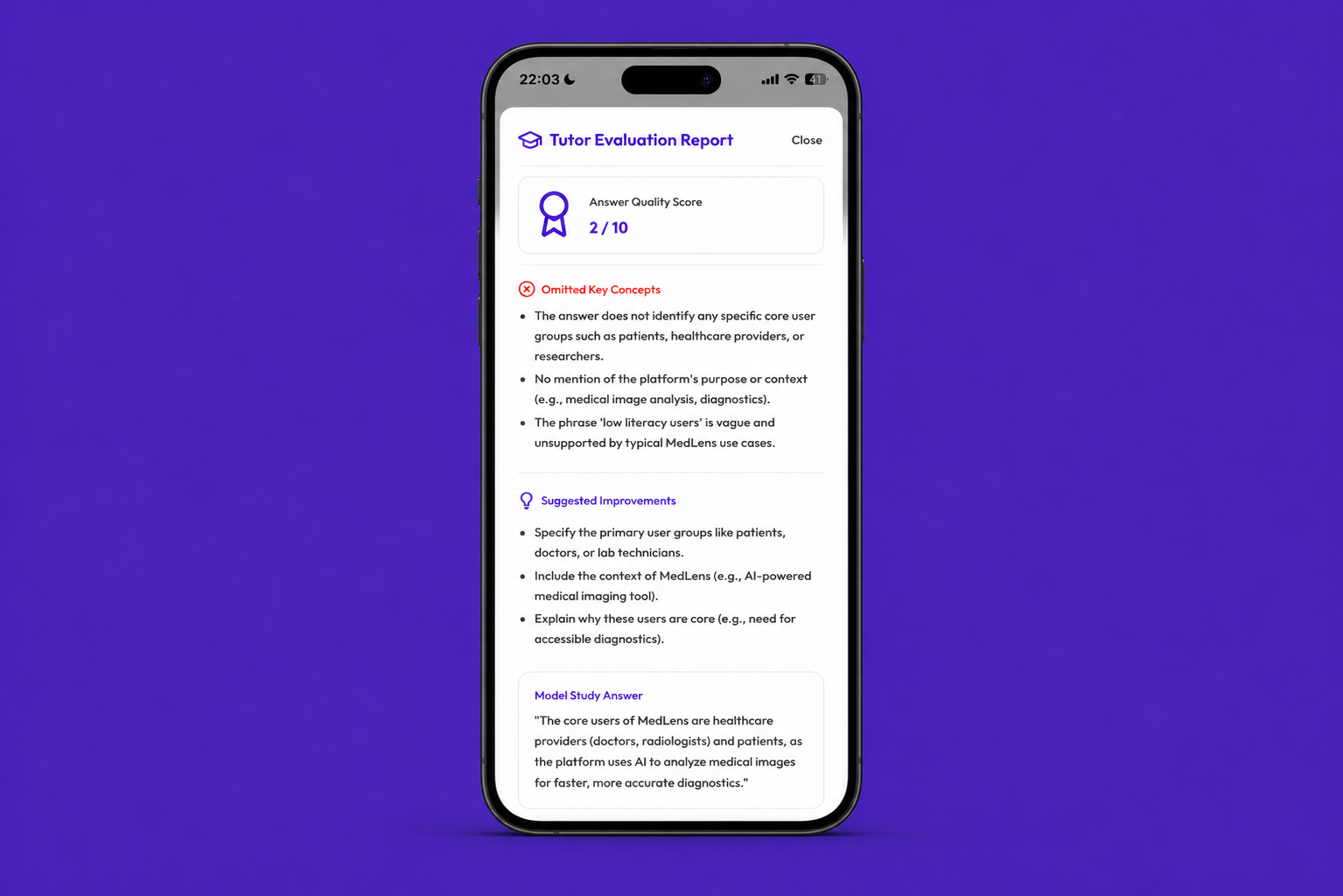
One of the most intentional product decisions in StudyEezy was limiting AI's role inside Study Rooms.
Instead of immediately answering questions, AI only participates after students have attempted to answer.
It reviews responses by:
- Identifying strengths.
- Highlighting missing concepts.
- Suggesting improvements.
- Providing constructive feedback.
- Presenting a model answer for comparison.
This approach encourages students to think before relying on AI.
Voice Input
Voice input enables students to interact naturally with StudyEezy, making the platform more accessible and convenient, especially on mobile devices.
Offline Learning
Previously generated summaries, flashcards, quizzes, uploaded materials, and study history remain accessible offline through Progressive Web App capabilities.
This allows students to continue learning wherever they are.
Features Deferred
To maintain a focused MVP, several ideas were intentionally postponed.
Examples include:
- Teacher dashboards.
- Video study rooms.
- Audio study rooms.
- Whiteboard collaboration.
- Subscription plans.
- Classroom management tools.
- Learning analytics.
These ideas remain part of the long-term product vision but were not essential for validating the platform's core value proposition.
User Flow
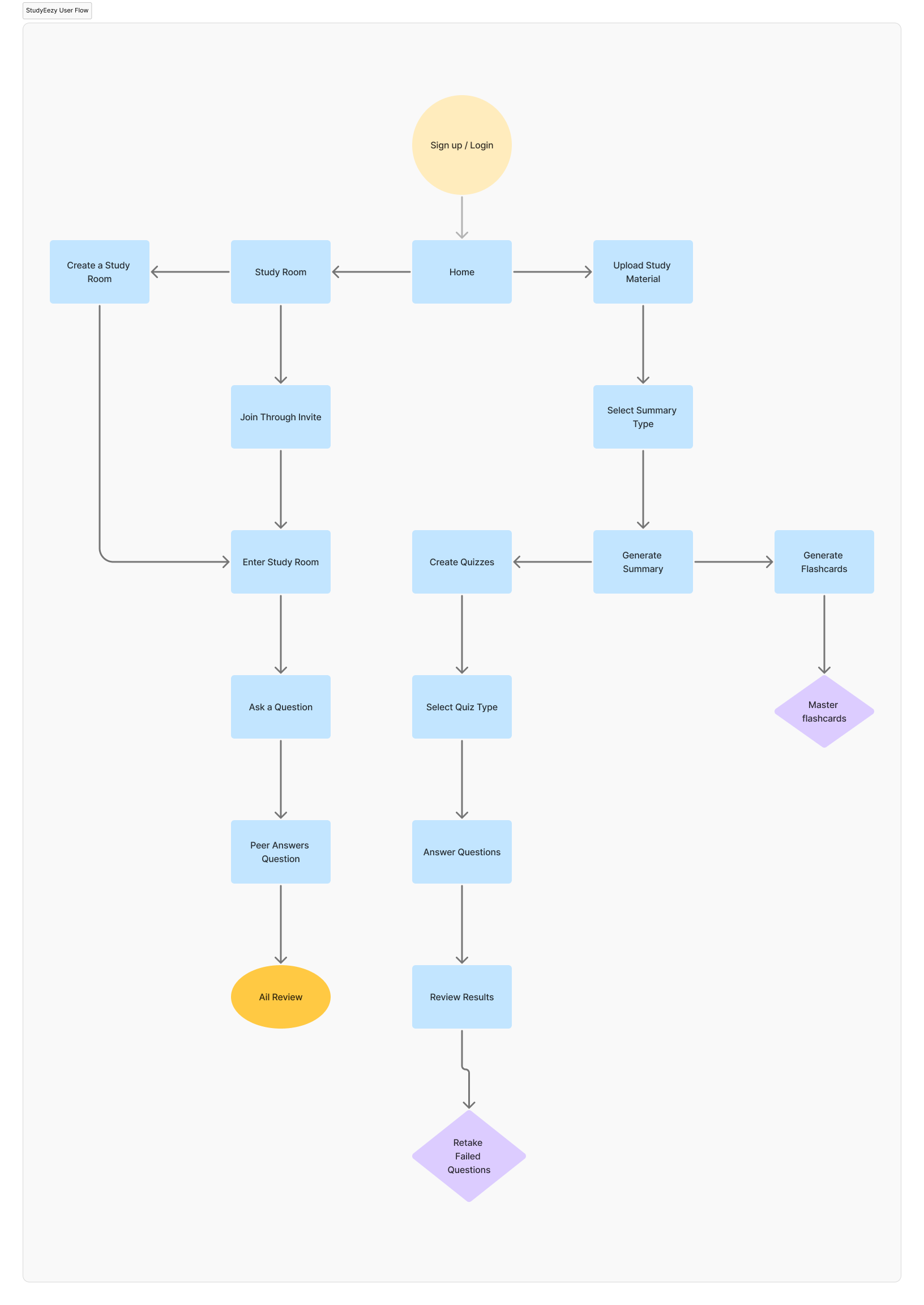
The flow was designed to keep students focused on learning rather than navigating the application.
Wireframes
Early wireframes focused on simplifying the learning experience.
Special attention was given to:
- Navigation.
- Content hierarchy.
- Mobile usability.
- Reducing cognitive load.
- Supporting long study sessions.
Multiple iterations helped refine both the dashboard and study workflows before moving into visual design.
Design System
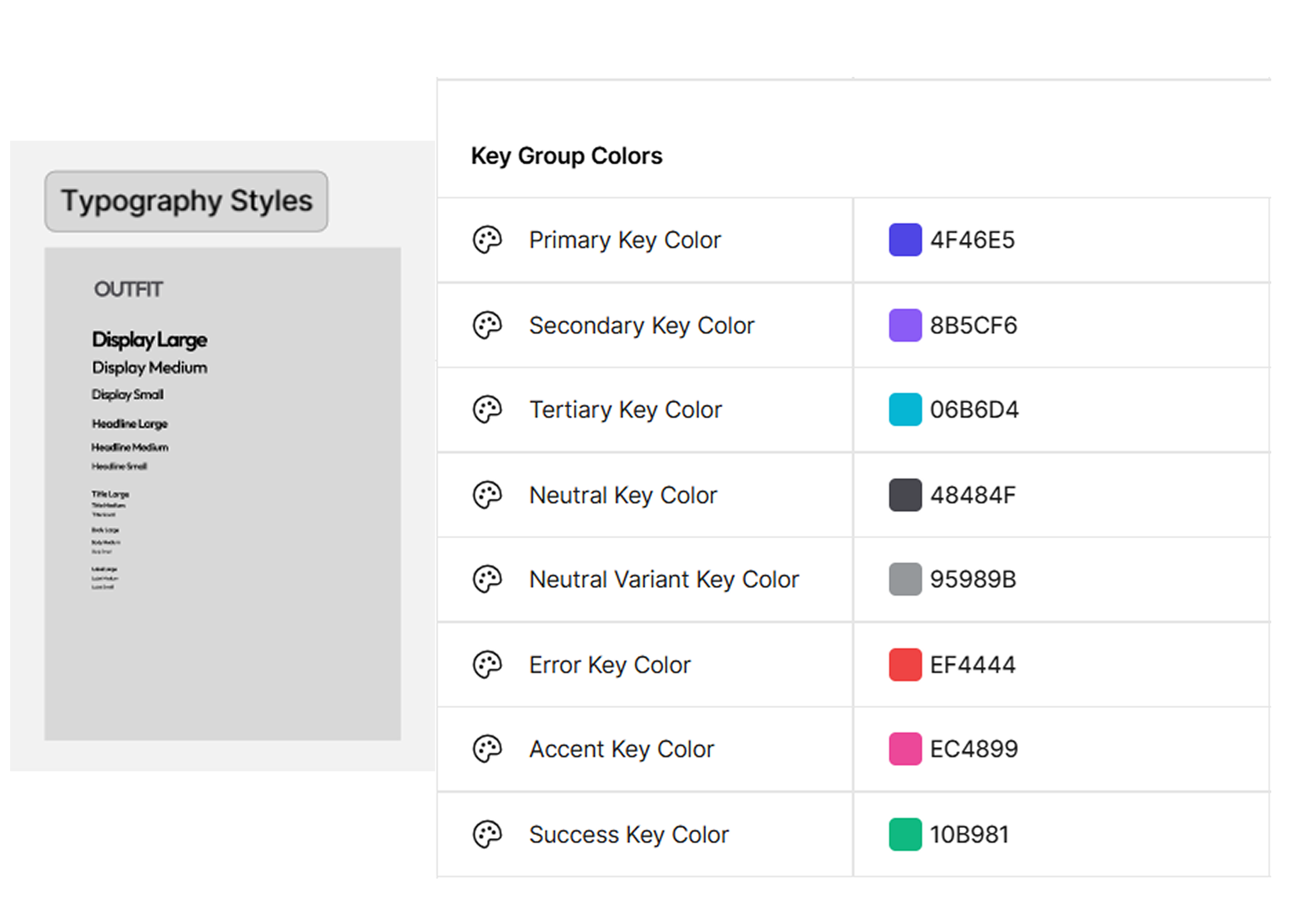
Consistency played an important role throughout the project.
A reusable design system was created to standardize:
- Colors.
- Typography.
- Components.
- Buttons.
- Form controls.
- Icons.
- Spacing.
- Layout patterns.
The system ensures a cohesive experience while making future product expansion easier.
High-Fidelity Designs
The final interface emphasizes focus, clarity, and simplicity.
The design minimizes distractions, allowing students to concentrate on learning rather than navigating the interface.
Every screen was optimized for mobile-first use while remaining fully responsive across larger devices.
Challenges
Building StudyEezy wasn't just about integrating AI into a learning platform. The biggest challenge was deciding where AI should help and where it should intentionally step back.
Every product decision had to support one principle: AI should improve learning without replacing it.
Preventing AI Dependency
One of the biggest product challenges was resisting the temptation to let AI answer every questionStudents are encouraged to attempt answers, discuss ideas with peers, and think critically before requesting AI feedback.
Balancing Simplicity With Flexibility
The interface was intentionally designed to guide students naturally from one learning activity to the next while minimizing unnecessary complexity.
Building A Complete Learning Workflow
Designing a workflow where each feature naturally supports the next was an important product challenge that influenced both the information architecture and the overall user experience.
Key Learnings
This project strengthened my ability to:
- Transform personal experiences into product opportunities.
- Design products around clear product principles.
- Balance AI capabilities with user needs.
- Build feature ecosystems instead of isolated features.
- Design mobile-first learning experiences.
- Connect UX strategy with product engineering.
Most importantly, it reinforced the importance of solving meaningful problems instead of simply building impressive technology.
Closing Thoughts
StudyEezy began with a simple realization from my undergraduate years: the most effective ways to study were also the most time-consuming to prepare.
Rather than using AI to replace the learning process, I saw an opportunity to use it to remove the repetitive work that often prevents students from engaging in active learning. That philosophy shaped every design and engineering decision throughout the project.
StudyEezy reflects how I approach product design today, start with a real problem, design around human behavior, use technology intentionally, and create experiences that make complex tasks feel simple.